
|
||||
|

A place to call home
5/23/2012 10:10:57 AM
By Kelly Moore
Splash Staff Writer
"I was like, ‘Yeah right,'" Southerland said. "If it sounds too good to be true, it is."
Only it was true.
The program was established in late February when Chase donated 100 homes from the bank's inventory to provide assistance to military families and wounded warriors.
Advertisement
"This is an incredible gift from Chase to our men and women in uniform," President and CEO of Operation Homefront Jim Knotts said. "Chase's imaginative, nationwide approach to providing quality homes to deserving service members and their families will make a huge difference in how these heroes can make that difficult transition and adjustment into productive civilian lives."
Southerland and his wife, Arlene, moved into their mortgage-free Liberty Lake home on April 23. For Keelan Southerland, a Spokane native since 1993, the move was a homecoming. But the couple's journey home was years in the making.
Military service
Keelan Southerland joined the National Guard in 2006, and made stops in Wisconsin, Kuwait, Iraq and Texas before earning medical retirement. He volunteered to deploy twice before making it to his post running convoys through the Diyala Province of Iraq, near Baghdad.
"I wanted to deploy," Keelan Southerland said. "What good is a soldier if he doesn't do his job overseas in a combat zone? That's what we're trained for and it's a waste of government money if we never put those skills to practice."
Southerland explained that National Guard is different from active duty, because it can backfill different job fields if someone volunteers.
He first volunteered to go in 2007, but dislocated his kneecap during his assignment training. After about a year of rehabilitation, he volunteered again for deployment, was cleared by his doctors and in the summer of 2008, headed overseas.
While working convoy duty, Southerland worked as a gunman for vehicles carrying essential supplies across hostile territory. He said he feared IED attacks, which seemed to be the biggest problem at the time.
"They were our biggest threat," he said. "It was all over TV and they made a big deal about it. We had vehicles that were supposed to protect from it, but bad guys kept coming up with new ways to defeat the stuff we had."
On Dec. 24, 2008, a rocket hit his truck. The vehicle was flung into the air and destroyed. A colleague was left in critical condition. Southerland walked away with his own serious, but hidden, injuries.
"They took me away from gunning after that mission, to driving," he explained. "What they didn't know at that time, was my back was actually broken. Sitting in those vehicles and getting jostled around ended up making the injury much worse."
He said he endured the pain until April 14, 2009, when his truck was attacked again. A high-intensity laser blinded most of the crew in his vehicle.
After a handful of eye tests, he was evacuated from Iraq and hospitalized in San Antonio. Here, he would face a different kind of battle - one for his well-being. Area Memorial Day weekend events:
LL Community Memorial Day salute and breakfast
Pavillion Park, 727 N. Molter Road, Liberty Lake
The Liberty Lake Rotary Club will sponsor a Memorial Day pancake breakfast May 28 at Pavillion Park from 8 to 10 a.m.
Cost is $6 for adults and $4 for kids. Proceeds from the event will benefit the Honor Flight program for military veterans. All local veterans are invited to the breakfast at no cost.
The morning will include a musical program, Honor Guard and a special Memorial Day tribute to veterans. For more information, contact Jeff Duncan at 868-6754.
Fairmount Memorial Services Programs
Fairmount Memorial Park, 5200 Wellesley Ave., Spokane
The cemetery staff will be available onsite May 26-28 to answer questions and help locate specific sites. Small American flags will be handed out all three days and the Flag Museum at Cutter Rock Chapel will be open from 10 a.m. to 3 p.m.
A Memorial Day service will be held May 28 at 11 a.m. Spokane Mayor David Condon will speak. The mayor will be accompanied by Marine rifles and local Boy Scouts.
Greenwood Memorial Terrace, 211 N. Government Way, Spokane
A brass patriotic band concert will be held onsite at 6 p.m. May 27.
The cemetery staff will be available onsite May 26-28 to answer questions and help locate specific sites. Small American flags will be handed out all three days.
Riverside Memorial Park, 508 N. Government Way, Spokane
The cemetery staff will be available onsite May 26-28 to answer questions and help locate specific sites. Small American flags will be handed out all three days.
Splash photo by Kelly Moore
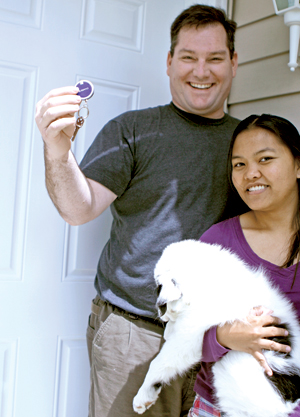
Keelan and Arlene Southerland pose outside their home with the newest member of their family, a puppy named Sam. The couple moved in April 23.
On the mend
Southerland said his biggest obstacle was enduring multiple spinal surgeries. Doctors fused three vertebrae in his lower spine and, although he's mobile, he'll deal with lasting effects for the rest of his life.
"It's hard to tie your shoes," Southerland said. "Mowing the lawn is difficult. Getting in and out of the car is difficult. My injuries are all on the inside. There are guys out there who are burn victims or amputees. They were hit pretty hard."
He said most of the effects from the laser have worn off and his eyesight, for the most part, is restored. During his time down south, he said a network of fellow wounded warriors and support services made his stay bearable.
"The good thing about Texas was the hospitality," Southerland said. "The people there were so polite and they supported the troops with more than just words or bumper stickers. They'd throw barbecues and stuff like that."
He also felt support when it came time for his then-fiancé to make the expensive trip from her home in the Philippines to Texas. Through his work with the Warrior Family Support Center (WFSC), he learned about a program that connects families with free flights.
He met Arlene while in the Philippines in November 2010. Soon after, they were engaged and working on immigration paperwork. After her visa was approved, he talked with a co-worker from WFSC about bringing her over.
"My co-worker said, ‘Let me make a few calls,'" Southerland said. "About two days later she called me back and said, ‘I need her Visa and all her paperwork as soon as you can get them.'"
Arlene finally made her way over to the U.S. on Aug. 23, Keelan's birthday. They were married in September.
‘A place to barbecue'
After getting married, the couple started researching housing options - and Keelan remembered his friend's mention about Operation Homefront.
"Every day, we work to give military families financial security so that when service members are in harm's way, they don't have to worry about their families back home," Knotts said. "The homes provided by Chase takes that one step further, and will provide these families with additional peace of mind concerning their futures."
At the time, the newlyweds were staying in a small, two-bedroom apartment. They both wanted to start a family. Arlene suggested checking out Homes on the Homefront.
"We got on the Internet and started doing a little research," Southerland said. "We found these houses that were available and, sure enough, there was one in Liberty Lake."
They made an application to be considered for the home. To be eligible, recipients had to be active duty, Guard or Reserve, or have been honorably discharged; not currently own a home and be financially capable of sustaining the home throughout an initial transition period and beyond. The program also considered history in the particular location.
"We got to talking and praying about it a bit," Southerland said. "I had a peace about it. We talked a lot about how cool it would be, but it was always like we were dreaming. It's still hard to believe it all came true."
After the initial application, the couple learned Operation Homefront administrators shortened the list to four finalists and they were still being considered. The following week was full of additional paperwork, and nearly unbearable anticipation.
"They called me on a Thursday," Southerland said. "The lady said, ‘I have a couple questions for you,' and my heart just sank. I was thinking the worst. But she just wanted to know if I have a problem with stairs, because of my injuries. I said it would be fine and she said, ‘Well, the house is yours. How soon can you get there?'"
That instant, he said, their lives changed. Arlene recalls "hugging and laughing, crying happy tears."
"It's kind of a blessing for us to have this house," she said. "When we first got here and saw the house, we just looked at each other and were both like, ‘Wow. It's really beautiful.' There's no need for us to ask for more because we already have this great blessing."
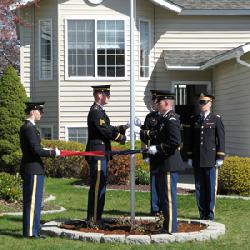
A local friend of Keelan's, and fellow veteran, organized a flag raising ceremony when they moved in. Operation Homefront made sure to install handrails in the stairway to make the climb easier for Keelan, and an epoxy flooring in the garage to lessen his chances of slipping.
Now, about a month later, the couple is still getting their bearings and settling in. A few boxes still need unpacking. Arlene started a small garden. Friends came over last weekend to barbecue on the deck.
For the most part, Keelan said they feel like their mortgage-free home opens the door to a wealth of opportunities - something he and Arlene both can afford to patiently evaluate. He's considering going back to school or finding a job working security. Arlene has a bachelor's degree in nursing.
Southerland said he knew the home wasn't recompense for his time served, but he appreciated Chase and Operation Homefront looking out for the soldiers who made decisions like his.
"I didn't start a career," Keelan said. "I didn't get married when I was young because I knew I was called to be a soldier and I was busy going to do soldier things. I was trying my best to be a soldier and for me, that kind of meant forsaking the normal parts of life. Now we're up there with most of our peers as far as having a home, a place to barbecue and start a family."