
|
|||
|
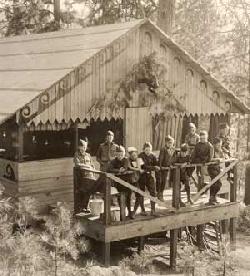

History: George Libby’s work with youth included LL camp
6/1/2011 10:33:28 AM
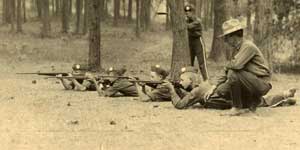 Photo courtesy of the Liberty Lake Historical Society An early pamphlet describing George Libby's Boys' Camp included this photo with the description: "This camp is affiliated with the National Rifle Association Junior Corps. ... Strict military supervision by the camp director is a fast rule at all rifle practice." |
By Jamie Wolff
for the Liberty Lake Historical Society
Ross Schneidmiller, our Liberty Lake historian, mentioned to me George Libby had a boys camp on Liberty Lake. I did not know this, but I offered that as an 8-year-old, I hiked with "George" and learned to shoot a .22 rifle under his instruction. I knew little of George's life and nothing about his connection to Liberty Lake. I agreed to look up facts and write an article. What I discovered was a man who dedicated his 93-year life to Spokane area youth. His first summer camp was at Liberty Lake. His motto: "Aim high and keep straight."
George had his first boys' camp here at Liberty Lake from 1918 to 1926 on what was then Kalez family property and what is now Spokane County's Liberty Lake Regional Park at the south end of the lake.
I remember hiking with George and other 8-year-olds on one of those bright, in-between fall days which started out cool and crisp and warmed up during the afternoon. My mother made me wear my heavy red plaid wool overcoat and matching wool hat, which quickly overheated me on the trail as we approached the Bowl and Pitcher on the Spokane River. I had no place to ditch that hot and heavy coat - I was stuck with that thing all day!
We arrived at the trailhead and hopped out of George's station wagon overloaded with green canvas bags stuffed with kindling wood. Other packs were heavy with cast-iron frying pans and still others sheathed axes, shovels and more gear. There were packs full of cans, cooking utensils and food, and metal canteens all over the place.
We were met by carloads of other young fellows and some older boys who seemed to know their way around. These older guys were carrying out George's orders. George gathered us at attention on the trailhead to count heads, and he sent the older fellows packing off in a different direction lugging the heavy packs. One of the older guys had a big truck tire which he, with the help of another, was rolling and wrestling up the hill where the big guys were headed.
Advertisement
To learn more about "George," I visited the "Northwest Room" at the Spokane Public Library. A reference librarian shared a file full of information, but it hardly had a word about Liberty Lake. There was even a live interview with George Libby that had been transcribed because, you see, he was one of the few people who lived in Spokane since before the turn of the last century. He came to Spokane about 1884.
The file contained his biography, his obituary, oral history, newspaper articles, awards, all kinds of materials on Mr. Libby.
Almost every Saturday during the spring and fall, George took dozens of young boys on day hikes. The hikers would gather at George's home and depart in various vehicles for the trailhead. Such was the hike that took me to the Bowl and Pitcher, where we hiked around a hill toward the river. As we approached a clearing below the hillside and could see the river down below, George waved to the older boys who had set off in a different direction from his station wagon and told us what was to happen next.
He explained that when he gave the signal (waving his well-worn scout hat), one of the boys would roll a large truck tire from the top of the hill down the hill into the river. We were being treated to the exciting spectacle of a huge tire rolling and bouncing and jumping and bumping and jerking around until it finally ended in the river. George positioned us carefully as a group so even the youngest hiker could see the top of the hill in the path of the tire.
George asked us all what would happen if the tire got off the path and headed toward us standing here on the edge of the trail? "It could kill somebody!" After some heavy worries for 8-year-olds, George said he would have to "take that tire." We understood that meant George would jump in the path of the tire to protect us. We became very worried about the direction of the tire down the hill. George gave the signal - the tire was off!
Afraid and with rapt attention, we all watched intently and worried as the tire picked up speed bouncing and bumping and careening down the hill generally in the direction it was supposed to go, rapidly approaching the river and finally disappearing with a bounce and a splash. Boy, were we all relieved that our hero George did not have to "take that tire."
 Splash graphic by Sarah Burk |
I tracked down one of my third-grade buddies, Dana Martin, who camped at Arrow Boys Camp on Lake Coeur d'Alene with George. He recalled the daily camp routine, which included standing for inspection after cleaning his cabin. He had a laugh as he told me of his horse, "Monkey," which was slow to start in the morning. When it was time to go back to camp, Monkey took off and galloped for the barn, scaring Dana who was hanging on for life. At evenings around the campfire, Dana enjoyed George's scary stories, only to fall into his sleeping bag exhausted every night by 9 p.m.
George started his summer camps at Liberty Lake about 1918. In 1926, he moved camp to Arrow Point on Lake Coeur d'Alene. His camp carried on into the 1960s. According to a promotional pamphlet, the broad range of activities offered included swimming, boating, hiking, woodscraft, nature study, trap shooting, archery, dramatics, music, photography, art, fencing, tennis, boxing, baseball, basketball, football, track and scouting.
In my research, I learned George began walking and hiking in the Spokane area first alone and then accompanied by friends sometime near the turn of the 19th century as a way to deal with his melancholy over the death of his childhood sweetheart, whom he intended to marry. He started to make his living as a portrait photographer. For a break from his darkroom, he began walking or hiking around the area. His hikes and explorations expanded, and more and more young people joined him. This activity became his vocation.
George's hikes and activities for boys near the turn of the last century predated the Boy Scout movement, which started in 1910. Fred Utter, the local Cadillac dealer, gave George a 1949 Pontiac station wagon that must have been the station wagon full of musty smelling canvas packs in which I rode to the Bowl and Pitcher for my hike. George was long involved with the Boy Scouts and received its highest award in service to young people, the Silver Beaver Award. George was an honorary member of Rotary Club 21 in downtown Spokane. Mayor David Rogers proclaimed Sept. 13, 1970, George Libby Day in the City of Spokane. George was named the Eastern Washington State Historical Society's Pioneer Man of the Year of 1966, where he was introduced at a banquet by none other than Harper Joy of Liberty Lake. George passed away in 1973. He was 93.
The awards he received, as great as they were, did not do justice to the guy who started his boys' camp at Liberty Lake, turned his avocation into his vocation and helped thousands of Spokane area boys "aim high and keep straight."
Jamie Wolff practices law in the Valley with Scott Hislop. Jamie's grandparents rented summer cabins at the lake in the 1920s. Jamie's parents and sisters "summered" here in the ‘50s and ‘60s. Since 1979, Jamie and Jackie Wolff have lived at the lake, where they raised their four sons.
GEORGE LIBBY'S BOYS' CAMP
Description
Dates of Operation
1918-1926 in Liberty Lake
Owner
George Libby
What's there today?
The site of the camp is now Spokane County-operated Liberty Lake Regional Park.