By Hope Brumbach
Splash Editor
The officers in blue are going green.
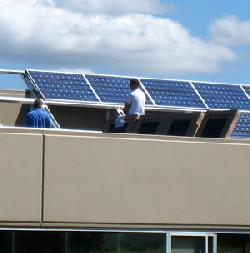
The Liberty Lake Police Department now is equipped with a bank of solar panels attached to the facility's roof, aimed to the south to soak in the sun's rays.
The panels are intended to conserve energy and will allow the department to continue operating in the case of an extended power outage, Police Chief Brian Asmus said.
The 60 solar panels should produce 14 kilowatt-hours of power, with an estimated production of 17,000 kilowatt-hours a year. The average household uses about 12,000 kilowatt-hours annually, said Justin McLane, owner of The Solar Stone LLC, which installed the solar panel system.
Advertisement

The roughly $123,000 solar panel system, which should be in operation soon, is paid for by an Energy Efficiency Conservation Block grant the city won last year. The grant is through the state Department of Commerce and American Recovery and Reinvestment Act.
The police department may be the only public facility in the region - and possibly the state - that is run by solar power, city staff said, according to their research.
The grant, worth nearly $135,000, also allows the city to green up other conservation efforts, including reducing energy usage in other city departments and educating the community, such as through a web monitoring system for the public to access the police department's energy savings.
"This is such a progressive town. How can we showcase this to catch on in the community?" said Michelle Griffin, the city's accounting technician and the grant author. "They can check out the website and say, ‘Wow the police department is saving 70 percent and at times, net metering.'"
|
By the Numbers
17,000
The estimated kilowatt-hours the police department's solar panel system should produce annually
60
Number
of panels in the system
162
Length in feet of the solar panel bank
$123,000
Cost for the
solar panel
system, paid
by a grant
|
The city also contributed nearly $22,000 in matching funds for the grant, which ends April 2012. The city's portion pays for a half-time energy conservation coordinator and other conservation services.
As part of the grant, the city formulated an energy conservation plan, which includes energy-efficient lighting throughout the city's facilities and also encouraging staff to conserve, such as through electronic usage, temperature control, reducing paper usage and even exploring a four-day workweek.
"It's catching on. You hear people say, ‘Hey, did you turn out the lights?'' Griffin said. "With the city's budget the way it is, this is a nice component to that problem."
The plan also includes reducing the staff's reliance on cars. Last spring, the city won an Association of Washington Cities grant to purchase a bike and helmet for staff to run short errands.
At the police department, 23127 E. Mission Ave., the solar panel system, which is backed by a bank of batteries, will allow limited operations to continue for two to three days of no sunlight. The batteries store up excess energy, which also can be sold back to the utility during sunny times.
Chief Asmus said the department had investigated purchasing a generator in the case of an extended blackout to make sure officers still could access the computer systems and charge phones and radios.
"For us, that was huge because it's something we talked about when we moved in here," Asmus said of the solar-powered backup.
The city also can capitalize on annual rebate incentives for using solar panels. After the solar panel system's first year in operation, the city will have a clearer picture of the overall savings, city staff said.
The city is planning an open house for late September to showcase the solar panel system. The event also will include kid-friendly demonstrations of uses for solar power, city staff said.
"It's not that much money," Griffin said of the total grant amount, "but if every city does this, maybe it will change things for the better."